


I. Concept and Classification of HSK Toolholders
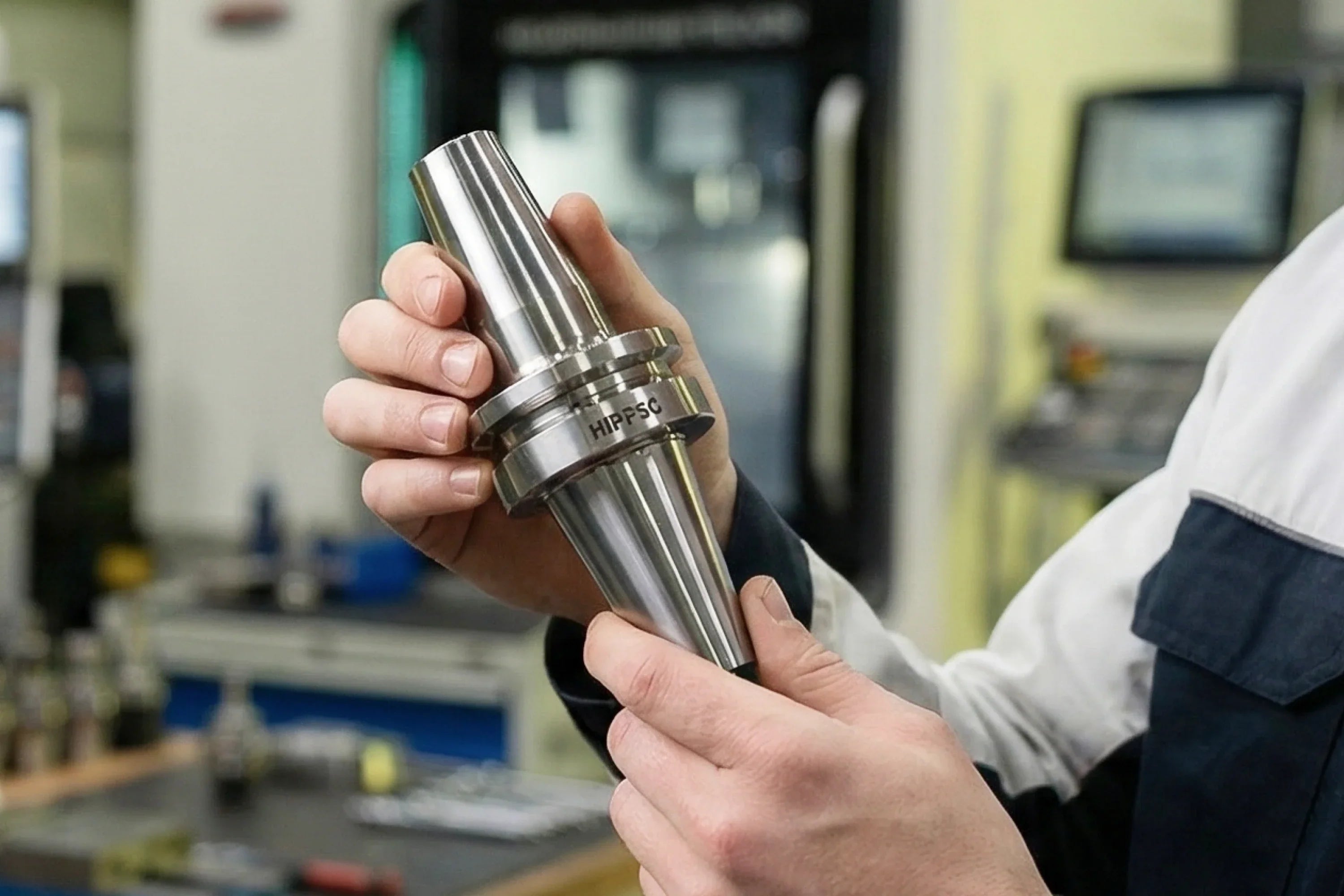
HSK toolholders originated in Germany and represent the Hollow Short Taper (Hohlschaftkegel) tool interface system. They are widely used in modern high-speed machining centers.
Unlike traditional BT toolholders that rely on a 7:24 single taper, HSK uses a 1:10 hollow short taper structure. This design creates a dual-contact interface where both the taper surface and the flange face contact the spindle.
This dual-contact design significantly improves:
- Spindle rigidity
- Positioning accuracy
- High-speed stability
- Repeatability during tool changes
According to DIN 69893, HSK toolholders are classified into several main types.
Common HSK Toolholder Types
HSK-A Type
- Most widely used standard
- Includes drive keyway for high torque transmission
- Suitable for automatic tool changers
- Common in general and heavy-duty milling
HSK-B Type
- Designed for fixed machining applications
- Medium torque capacity
- Supports automatic tool changing
HSK-C / HSK-D Types
- Manual tool change versions of A and B
- Used on machines without ATC systems
- Designed for ultra-high-speed machining
- No keyways for perfect symmetry
- Excellent dynamic balance
- Typically used above 40,000 RPM
- Similar symmetrical design to HSK-E
- Optimized for medium-speed machining
- Often used for soft materials
To support modern turning-milling centers, HSK-T toolholders were later developed.
HSK-T significantly reduces circumferential clearance between the toolholder keyway and spindle drive key, improving tool tip stability during turning operations.
---II. Common Questions
What is the difference between HSK-A and HSK-E?
The primary difference is torque transmission and application.
- HSK-A uses a drive keyway to transmit high torque. Ideal for heavy milling.
- HSK-E relies purely on friction between taper and face contact, enabling better balance.
Using an E-type holder for heavy cutting can cause tool slippage, while using an A-type at ultra-high speed may introduce vibration due to the keyway.
---Why is the HSK-T toolholder more expensive?
HSK-T is designed specifically for turning-milling centers.
Standard HSK-A holders allow approximately 0.17 mm circumferential clearance. During milling this is acceptable because the tool rotates.
During turning operations, however, the tool tip remains fixed. This clearance can cause dimensional variation after each tool change.
HSK-T reduces this clearance to approximately 0.04 mm, improving positioning accuracy by more than four times.
HSK-T holders also require stronger spindle clamping force (HSK-T63 ≈ 24 kN vs HSK-A63 ≈ 18 kN), which increases manufacturing precision and cost.
---III. Benefits of Proper Toolholder Selection
1. True High-Speed Machining
The dual-contact interface of HSK eliminates precision loss that occurs in traditional BT holders during high-speed rotation. Symmetrical HSK-E and HSK-F holders provide excellent stability above 40,000 RPM.
2. Higher Rigidity and Cutting Efficiency
HSK holders typically provide 5-7× higher system rigidity compared with conventional BT holders. This allows higher metal removal rates when machining difficult materials such as titanium alloys.
3. Stable Precision for Complex Machining
For turning-milling centers, HSK-T toolholders eliminate tool tip deviation caused by clearance in standard holders. This reduces setup time and improves production consistency.
---HSK Toolholder Comparison
| Feature | HSK-A | HSK-E | HSK-T |
|---|---|---|---|
| Core Advantage | High torque versatility | Ultra-high-speed stability | Maximum turning precision |
| Torque Transmission | Keyway + Friction | Friction | Precision Keyway + Friction |
| Max Speed | Medium-High | ≥ 40,000 RPM | Medium-High |
| Circumferential Clearance | ~0.17 mm | Not applicable | ~0.04 mm |
| Typical Application | Heavy milling | Precision molds, micro-machining | Turning-milling centers |

Leave a comment
All comments are moderated before being published.
This site is protected by hCaptcha and the hCaptcha Privacy Policy and Terms of Service apply.